
Category: Personal development

  • 🐺 Jealousy – The “Guard Dog” of Toxic Relationships

    🐺 Jealousy – The “Guard Dog” of Toxic Relationships

    A deeper look into an emotional shadow often mistaken for love

    Jealousy is a feeling known to almost everyone. Often romanticized, justified, or minimized, it is even called “proof of love” in many relationships. But in truth, jealousy is not love. It is fear — of loss, rejection, and abandonment. And in many cases, it becomes the watchful guardian of a toxic connection, feeding on what silently destroys relationships: trust, freedom, and authenticity.

    🔍 What is jealousy, really?

    Jealousy is a reactive emotion — a cocktail of fear, insecurity, and mistrust — triggered by the perception that an important relationship is under threat. It can arise between partners, friends, siblings, or colleagues. But the root is always the same: the fear of being replaced in someone’s heart.

    In imbalanced or codependent relationships, jealousy becomes:

    • a tool for emotional control,

    • a subtle form of manipulation,

    • a sign of emotional dependency,

    • a mask covering deep self-worth wounds.

    🧠 In toxic dynamics, jealousy becomes a “guard dog”

    In toxic relationships, jealousy isn’t an exception — it’s a core feature. It becomes the justification for:

    • over-controlling behavior (checking phones, limiting freedom),

    • emotional manipulation (“If you really cared, you wouldn’t do that”),

    • intense emotional swings (“I love you / I feel betrayed”).

    The partners become trapped in a tense, reactive cycle:

    The more one becomes jealous, the more the other feels restricted or guilty.
    The more the other reacts or distances, the more justified the jealousy seems.

    This cycle creates emotional instability, false closeness, and conditional affection.

    👶 The roots of jealousy: wounds asking to be healed

    Jealousy rarely originates in the present. It’s often a reactivation of older wounds:

    • Fear of abandonment (inner child): “If I’m not seen, I’ll be replaced.”

    • Feelings of inadequacy: “I’m not enough, someone else would be better.”

    • Relational trauma: betrayal, rejection, neglect.

    • Insecure attachment style: associating love with uncertainty or inconsistency.

    ❤️ Jealousy vs. Authentic Love

    Jealousy Authentic Love
    Control and fear Freedom and trust
    Suspicion and accusations Open, conscious communication
    Imaginative assumptions Grounded choices in reality
    Possessive attachment Presence and respect
    Dependence and fear of loss Self-awareness and sovereign choice

    🧘‍♀️ How do we heal jealousy?

    1. Own it – Jealousy is your own emotion. Others may trigger it, but it is yours to understand and work with.
    2. Ask your wound – What deeper fear is jealousy protecting?
    3. Do the inner work – Jealousy is not solved by controlling others, but by empowering yourself.
    4. Communicate consciously – “When this happens, I feel unsafe and fearful,” instead of “You make me jealous.”
    5. Build self-love and healthy self-worth – The more whole you feel within, the less you’ll depend on external validation.

    🌿 Jealousy is a shadow longing for light

    We don’t need to demonize jealousy. It is human, understandable, and deeply rooted. But we must stop normalizing it as proof of love.

    When listened to with compassion, jealousy becomes an ally in healing.
    When acknowledged, it transforms into clarity.
    When integrated, it paves the way for real love – one that does not need to guard or possess, because it does not fear.

    🔚 Final Thoughts

    Jealousy doesn’t protect love.
    It protects fear.
    And when fear governs a relationship, love can no longer breathe.

    True emotional maturity is not about never feeling jealous.
    It’s about recognizing it, integrating it, and choosing conscious love over reactive attachment.

    #jealousyhealing #emotionalawareness #toxicrelationships
    #consciouslove #innerchildwork #emotionalintelligence
    #relationshipwounds #shadowintegration #spiritualgrowth
    #healingjourney #personaldevelopment #emotionalmaturity
    #jealousyisnotlove #traumahealing #selfworthfirst
    #trustandfreedom #mindfulrelationships #energeticsovereignty
    #selfhealingpath #codependencyrecovery

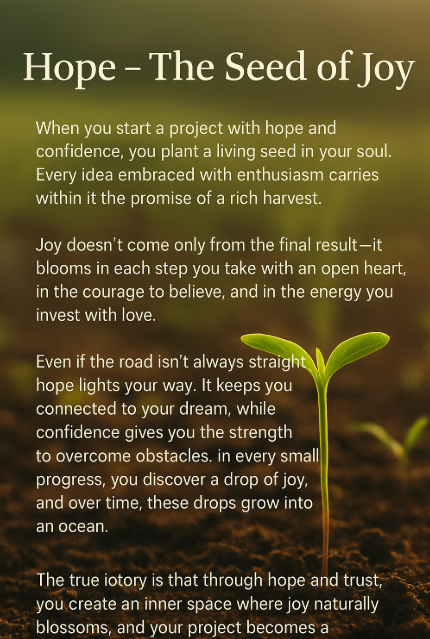
  • When You Begin with Hope and Trust, Joy Finds You on the Way

    When You Begin with Hope and Trust, Joy Finds You on the Way

    Hope isn’t wishful thinking; it’s the spark that turns an idea into movement. Trust isn’t blind faith; it’s the steady posture you hold when outcomes are still uncertain. Together they set a tone that doesn’t erase challenges, but transforms the journey into one that is meaningful—and quietly joyful.

    Why the beginning shapes the story

    The questions you ask at the start become your compass: Why am I doing this? Who does it serve? Who am I becoming as I build it? When your answers are honest, confidence stops depending on quick results and starts resting on integrity of direction.

    Joy as a practice, not a prize

    Joy isn’t only at the finish line. It appears:

    • in small wins (the first draft, the first client, the first kind review),

    • in clarity after mistakes,

    • in the right people who show up when your project has a heart.

    If you postpone joy “until I succeed,” you’ll keep postponing it. Practice it now—or you won’t meet it later either.

    Obstacles as feedback

    When delays or criticism arrive, two switches change everything:

    1. Curiosity over shame: What is this teaching me about the process?

    2. Adjustment over paralysis: What can I try differently tomorrow?
      In this way, hope becomes a method, not a fairy tale.

    The circle that lifts you

    Projects grow faster in shared light. Ask for and offer help. Say “thank you” often. Joy multiplies when you stop acting like a lone hero and build within a community of goodness.

    Simple anchors for good days

    • Morning ritual (5 min): one sentence of intention + one small, clear action.

    • Deep work (90 min): one target only, then 5 minutes to celebrate progress.

    • Evening journal (3 lines): what worked, what I learned, the next step.

    Boundaries and rest

    Confidence thins when you say yes to everything. Joy wilts without rest. Say no to what doesn’t serve the vision, and treat rest as part of the project plan.

    Beginning with hope and trust doesn’t promise perfection; it promises presence. And presence, practiced daily, becomes joy—not by accident, but as the natural echo of how you walk the path.

  • Surya Vajra – The Harmony Between Energy and Soul

    Surya Vajra – The Harmony Between Energy and Soul

    In a world where the pace of life becomes increasingly fast, the modern human drifts away from their inner source of balance. Surya Vajra, an energetic system born from the fusion of Eastern wisdom and deep spiritual work, serves as a bridge between the individual and their divine essence.

    Surya – the Sun – symbolizes pure energy, vitality, and the light that nourishes us at all levels. Vajra – the diamond thunderbolt – is the indestructible force of consciousness and clarity. Together, they form a unique vibration that brings harmony between body, mind, and soul.

    A Journey in Three Steps

    The Surya Vajra path is divided into three levels, each offering new tools and a deeper understanding of the self.

    • First Level opens the gate to Surya Vajra energy, clearing energetic blockages and balancing the energy flow in the body. The practitioner begins to feel the connection to their inner light and the universal source of energy.

    • Second Level introduces more advanced healing techniques, working on the physical, emotional, and mental planes. This is where old patterns are released, and the energy body is strengthened.

    • Third Level, the master level, provides special tools such as Fire Serpent Activation, Core Matrix Removal, and Shield Protection. These not only amplify energy power but also protect, transform, and raise the level of consciousness.

    Energy as a Friend and Master

    Surya Vajra is not just a healing method—it is an inner journey. The practitioner learns to work with energy not as an external tool, but as an extension of their own being. Every meditation, every activation, becomes a dialogue between the soul and universal energy.

    Through Core Matrix Removal, inherited patterns and emotional blockages are dissolved, opening the way to inner freedom. Shield Protection brings an aura of safety and peace, allowing spiritual growth without interference.

    The Harmony Between Energy and Soul

    Practicing Surya Vajra means living in balance. It means recognizing that you are not just your body, nor only your thoughts, but a divine spark capable of radiating light into the world. Energy becomes the link between all planes of existence, and the soul becomes the guide on this journey.

    In this harmony, one finds strength, clarity, and peace. And when energy and soul resonate on the same frequency, life itself becomes a manifestation of universal beauty and love.

    https://simonneelle.de/home/shop/surya-vajra-reiki-level-1-3/


  • Kind Words Open Doors – The Lasting Power of Politeness and Diplomacy 🍯💬

    Kind Words Open Doors – The Lasting Power of Politeness and Diplomacy 🍯💬

    In a world where communication is faster than ever, the tone and intention behind our words often matter more than the words themselves. The saying “Kind words open doors” captures an essential truth: respect, empathy, and tact in speech can achieve what force, haste, or aggression cannot. Whether in personal relationships, professional settings, or cross-cultural interactions, polite and diplomatic communication remains a timeless tool for connection and success.

    The Psychology Behind Kindness in Speech

    Words are more than mere sound — they carry emotional weight. Neuroscience shows that kind, affirming language triggers positive emotional responses, builds trust, and encourages cooperation. A gentle tone and respectful choice of words can instantly lower defenses, creating space for genuine dialogue. This psychological openness is the “door” that kind words unlock.

    Diplomacy: Speaking the Truth with Care

    Diplomacy is the art of communicating clearly without creating unnecessary conflict. It’s not about avoiding honesty, but about delivering it in a way that’s constructive. In professional negotiations, diplomacy helps preserve relationships while resolving issues. In personal life, it allows us to express needs and boundaries without harming mutual respect.

    Kind Words in Action

    • At work: Acknowledging a colleague’s effort before offering feedback increases the chance that your suggestions will be accepted.

    • In daily life: Simple courtesies — “please,” “thank you,” “I appreciate it” — can turn routine interactions into moments of mutual respect.

    • Across cultures: Kindness transcends language barriers, often acting as a universal gesture of goodwill.

    Why Kindness Works Where Harshness Fails

    Aggressive communication might force compliance, but it rarely fosters loyalty or cooperation. Kindness, however, invites voluntary engagement and strengthens long-term connections. In essence, people are more inclined to open both their minds and their hearts to someone who treats them with respect.

    Kind words don’t just open doors — they keep them open. They create opportunities for understanding, partnership, and reconciliation. In every conversation, we hold the power to either build walls or open pathways. Choosing kindness is not a sign of weakness; it is a deliberate act of strength, wisdom, and emotional intelligence.

  • 🎭 Iluzia Vindecării și Etica Terapeutului în Era Spectacolului Public

    🎭 Iluzia Vindecării și Etica Terapeutului în Era Spectacolului Public

    Trăim într-o epocă în care imaginea contează, iar spiritualitatea, vindecarea și dezvoltarea personală devin, din păcate, și instrumente de marketing. În acest context, apar personaje care se prezintă drept „terapeuți vindecați”, dar care folosesc drame personale sau „campanii de conștientizare” pentru a atrage atenția – nu în scop terapeutic autentic, ci pentru auto-promovare și validare egotică.

    Un semnal de alarmă apare atunci când acești terapeuți – ce pretind că și-au integrat traumele – încep să promoveze campanii de denigrare publică a unor foști parteneri, colegi sau „agresori”, prezentându-le ca pe acte de curaj sau dreptate spirituală. În realitate, astfel de acțiuni sunt adesea forme de manipulare emoțională, vendetă și victimizare teatrală, mascate sub pretextul „vindecării” și al „adevărului”.

    ❗ Unde este problema reală?

    • Vindecarea autentică nu strigă pe rețelele sociale și nu cere validare în aplauzele mulțimii.
    • Un terapeut cu adevărat conștient nu își face reclamă pe baza durerii, a scandalului sau a expunerii altora.
    • Etica profesională cere confidențialitate, compasiune și neutralitate, nu justiție populară și spectacol mediatic.

    Campaniile de „awareness” sau luptele personale?

    E ușor să confunzi activismul sincer cu răzbunarea rafinată, mai ales când publicul este emoțional și neantrenat în discernământ. Iar platformele online favorizează adesea emoția, drama și conflictul, în detrimentul adevărului și al maturității.

    Un exemplu relevant este modul în care unele persoane au preluat valul mișcării #MeToo. Deși inițial un demers necesar de a aduce la lumină abuzurile reale și sistemice, #MeToo a fost folosit de unii ca instrument de notorietate și influență, prin acuzații greu de dovedit sau prin dramatizări în lipsa unui proces interior real de vindecare. Astfel, trauma devine monedă de schimb, iar suferința personală este expusă teatral pentru a câștiga vizibilitate, adepți sau statut.

    Acești “terapeuți” – auto-declarați vindecați – își construiesc imaginea publică pe baza suferinței povestite, nu pe a vindecării integrate. În loc să creeze spații de transformare profundă, cultivă un cult al durerii publice, unde emoția devine capital simbolic.

    Ce face un terapeut autentic?

    • Ascultă, nu judecă.
    • Vindecă în tăcere, nu în aplauze.
    • Își respectă trecutul fără a-l transforma în armă publică.
    • Nu face din „agresorii” reali sau presupusi personaje negative în teatrul propriei iluminări.

    În loc de concluzie:

    Un terapeut autentic știe că vindecarea se face în tăcere, în profunzime și cu smerenie.
    Nu are nevoie să demonstreze nimănui că este „vindecat” și nu construiește autoritate prin ură mascată în „adevăr”.
    Dacă folosești rana ca monedă de schimb pentru influență, ai ratat vindecarea.

    Fii atent la terapeuții care își fac reclamă prin povestea propriei suferințe și prin acuzații publice. Vindecarea reală este tăcută, discretă și profundă – și nu are nevoie de spectatori.

    Videoclipul zilei :